
The jewelry craftsmanship is our great passion. That’s why it is particularly important to us that all our partners are just as passionate about the raw materials and sustainability as we are. Because: The piece of jewelry we design can only be as good as the materials we use as a foundation – and thus as good as our partners.

Working Together
Design & Maker
From hand to craft

Certifications
Sustainability and transparency play an important role for us at Maren Jewellery. That is why we work with certified partners throughout our supply chain and also have our own company regularly audited. Maren Jewellery is B Corp certified, a member of the Responsible Jewellery Council (RJC), and has been rated “Great” by Good On You, an independent platform.
Many of our partners also hold recognized certifications. Our precious metal refinery, C. Hafner, operates in accordance with the RJC Chain of Custody Standard, among others, and holds LBMA Good Delivery Status. Our lab-grown diamonds come, for example, from manufacturers such as Diamond Foundry, a certified climate-neutral company, or Fenix Diamonds, whose production is audited according to standards such as SMETA and the SCS-007 Jewelry Sustainability Standard. Other partners such as Schofer (RJC-certified, ISO 9001:2015) or Hoover & Strong (SCS Certified Responsible Source) also hold internationally recognized certifications.
Through this collaboration with certified partners, we want to ensure that our materials are processed as transparently and responsibly as possible throughout the supply chain.
18 Karat Recycled Gold
Our sustainable jewellery is made largely of gold. You can read more in detail about why we deliberately chose recycled gold in our journal on urban mining. An important partner in this is the Pforzheim refinery C. Hafner, with whom we have worked for many years.
C. Hafner's gold comes from recycling existing precious metals. According to the manufacturer, the recycling process produces around 29 kg of CO₂ equivalents per kilogram of recycled gold. (1) By comparison, studies suggest that newly mined gold can generate between around 16,000 and 32,689 kg of CO₂ equivalents per kilogram of gold, depending on the extraction method. (2)(3) This difference shows how significant the impact of raw material extraction can be on gold’s carbon footprint.
C. Hafner also works with a CO₂-neutral certified gold refining process based in part on green electricity and verified through DEKRA certification for the CO₂ neutrality of fine gold. In addition, the company holds LBMA Good Delivery status as well as the RJC Chain of Custody Standard, which supports transparency along the precious metals supply chain.
The C. Hafner refinery is a family-run company from Pforzheim with more than 170 years of history and around 240 employees. A large proportion of the precious metals comes from Germany and neighbouring EU countries and is returned there to the material cycle. Through this partnership, we at Maren Jewellery are able to use precious metals whose origin and processing are transparently documented.
Gold could not be more beautiful.


Synthetic Eco Diamonds
The second most commonly used raw material in our products is diamonds. For our jewelry pieces, we use lab-grown diamonds instead of newly mined natural diamonds. One reason for this is better supply chain traceability: according to our suppliers, the diamonds we use can be documented all the way back to their origin. If you’d like to learn more about this topic, feel free to visit our journal about synthetic diamonds.
We work with manufacturers including Fenix Diamonds (Belgium/India) and Diamond Foundry (USA). Both companies produce diamonds in the laboratory and, according to their own statements, place great importance on transparency throughout the supply chain. At Fenix Diamonds, the entire production chain—from growth and cutting to the finished diamond—can be traced. The company employs around 800 people and produces its diamonds in India. Production is partly powered by solar energy and is certified, among others, to SMETA and the SCS-007 Jewelry Sustainability Standard.
Another partner is Diamond Foundry from California. The company has been producing lab-grown diamonds since 2012 and, according to its own statements, is certified as a Certified Carbon Neutral Company. Here too, production is said by the company to be climate-neutral.
Lab-grown diamonds have the same chemical and optical properties as natural diamonds. At the same time, studies show that extracting natural diamonds from mines can involve significant disruption to landscapes and ecosystems. According to studies, mining one carat of rough diamond generates between 3,100 and 4,350 tonnes of overburden as well as about 2,675 tonnes of contaminated earth materials. (4)(5) In addition, average emissions of about 108.5 kg CO₂ equivalents are reported for the extraction of one carat of natural diamond. (6)
By comparison, studies report average emissions of about 11.8 kg CO₂ equivalents per carat for lab-grown diamonds. (4) These values may vary depending on the energy source and production method. Energy is also required to produce lab-grown diamonds, which is why many manufacturers are increasingly turning to renewable energy. According to our partners, both Fenix Diamonds and Diamond Foundry use renewable energy sources in part and state that they operate in a climate-neutral way.
By working with these partners, we aim to ensure that the origin, processing, and supply chains of our diamonds can be traced as transparently as possible. stop by.
Stud earrings
A small detail that is often overlooked with stud earrings is the earring backs. These inconspicuous components are often produced in large quantities in the jewellery industry, without it always being clearly traceable where they are made and under what conditions.
That is why it was important to us to find partners who are transparent about their production. Today, we work with Hoover & Strong in the USA and Cooksongold in the United Kingdom, among others.
Hoover & Strong is a family-run company that has been in business since 1912 and employs around 75 people. The company manufactures components for the jewellery industry and works in accordance with the SCS Certified Responsible Source Standard, among others. In addition, Hoover & Strong implements various measures to reduce environmental impact, for example through water treatment and more efficient refining processes.
Cooksongold, one of the leading precious metal manufacturers for the jewellery industry in Great Britain, also holds certification under the Responsible Jewellery Council Chain of Custody Standard (RJC CoC). This standard is intended to document precious metals transparently along the supply chain and to have this regularly verified
By working with partners like these, we can also trace where even the smallest components of our jewellery are produced and the standards under which they are made.

Designing jewelry can be a puzzle
Our essential chain
That's where Schofer comes into play. A production facility in Pforzheim for wonderfully delicate chains. Schofer produces the reduced Essential Chain for us from 18-carat recycled gold. This is an incredibly filigree chain – and we are more than happy to have found a partner who brings the professional knowledge and expertise to produce it exactly as we envisioned. We are also very pleased that Schofer is RJC certified.


Our silver chains
Because we wanted to offer our silver chains in recycled 925 sterling silver, there was only one choice for us: Fischer. A company from Idar-Oberstein whose values are as dependable as the materials they work with – and have been for over 70 years. But above all: they are just as exacting as we are. A craft business that takes the production of our chains as seriously as if they had designed them themselves. Designing jewellery can sometimes feel like a puzzle. We know which materials we need to make jewellery pieces. But where are we supposed to find them? Sometimes you're unlucky and they simply don't exist. For example: sustainable chain clasps. But that's exactly why we have our workbench. So we sat down and designed them ourselves. That gives us the raw materials for: rings, pendants, and earrings. For chains, we already even have everything. But: raw materials are not pieces of jewellery. That's why we still need a foundry to cast our gold and our silver into the right shape.
Maren Production Chain

Our foundry
Kauselmann is a foundry that completely avoids mined gold and manufactures in Pforzheim. According to its own statements, the foundry operates according to clear principles: responsible working conditions, avoiding mined gold, and a production process that conserves resources as much as possible. That is also why the foundry decided to use paper bags instead of the usual plastic bags for shipping its castings. This saves several million plastic bags! But where they do not cut corners is on jewelry of the highest quality, made to our exact specifications. Yet the raw casting alone is not a finished piece of jewelry. Now it is time for polishing.


Our master jewel setter
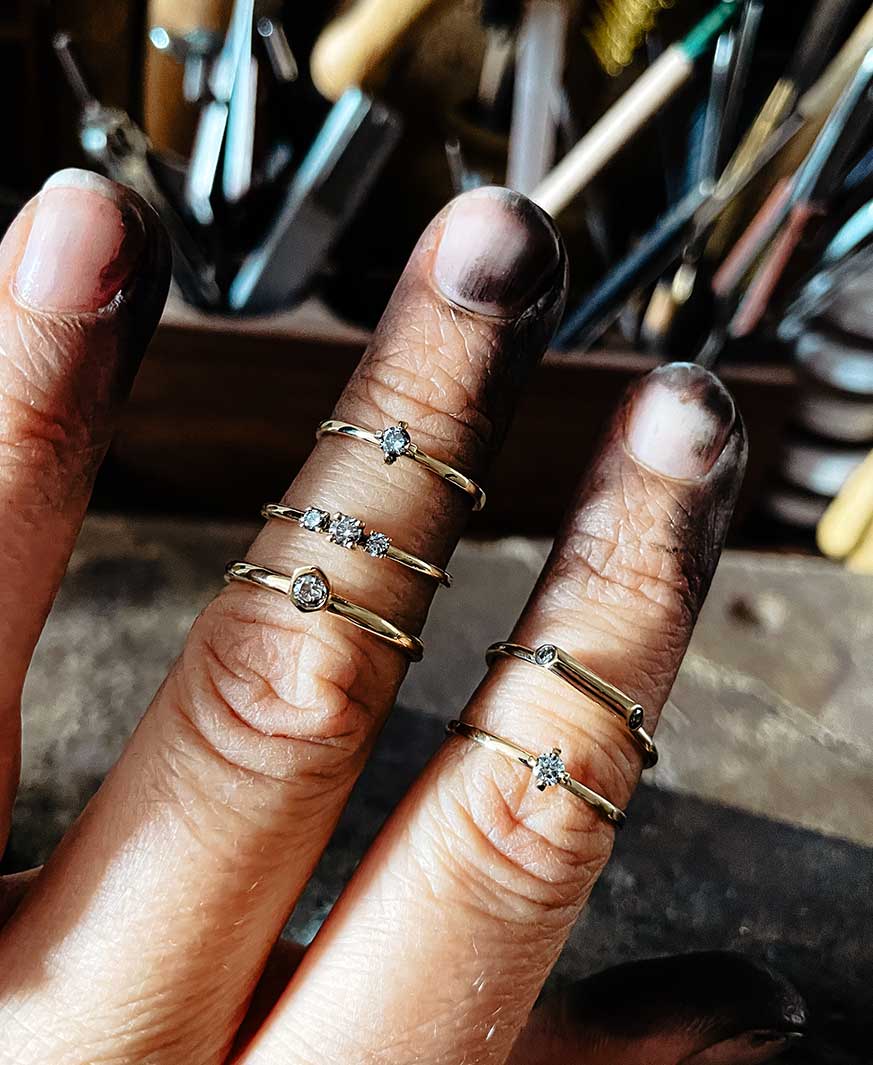
Let’s briefly recap: Our gold and silver were cast and polished. Earring backs were attached to the studs. Our necklaces were crafted. And we have lab-grown diamonds. But how do the diamonds become part of the jewelry? That’s where master stone setter Wilhelm Kling and his daughter Julia Kling come in. A traditional company from Pforzheim that has been practicing its craft since 1875. That is 145 years of experience. Experience that has won over many renowned customers. Every movement is second nature here, as every Maren Jewellery customer can attest.

The last glance
Now they all lie before us on the workbench: The chains and rings, bracelets and earrings. And we wouldn't be Maren Jewellery if we didn't get involved ourselves one more time. After all, it's what we love, what excites and fascinates us: The search for the perfect piece of jewelry. We take care of the final polishing and quality control, and of course, we work in an environmentally friendly way – without toxic chemicals, which is why we use citric acid instead of toxic acids for our pickling. Therefore, you can be sure: Each of our sustainable jewelry pieces goes through many conscientious hands, is examined by many knowledgeable eyes, and receives exactly what it needs to be one: Your new favorite piece.
Sources:
(1) Dr. Philipp Reisert, "What is more sustainable: gold mining or gold recycling" [Online] Available: https://blog.c-hafner.de/oekologischer-fussabdruck-wasist-nachhaltiger-goldgewinnung-oder-goldrecycling/. Accessed on 2021.05.10
(2) Fritz, B.; Aichele, C.; Schmidt, M., "Environmental impact of high-value gold scrap recycling" The International Journal of Life Cycle Assessment. 2020
(3) World Gold CounciL, "Gold and climate change – Current and future impacts" [Online] Available:https://issuu.com/christinadianparmionova/docs/gold_and_climate_change-current_and_future_impacts.Accessed on 2021.03.19
(4) Dr Gbemi Oluleye – Research Fellow Centre for Environmental Policy, Imperial College London, "Environmental Impacts of Mined Diamonds" 2019
(4) Better Diamond Initiative, "Environmental cost of mined diamonds is alarming" [Online] Available:https://betterdiamondinitiative.org/environmental-costof-mined-diamonds-is-alarming/. Accessed on 2021.05.18
(6) Standford Magazine, Andy Martin, "A Man-Made Diamond Is Forever, Too: Nitty-gritty" Online] Available: https://stanfordmag.org/contents/a-man-made-diamondis-forever-too-nitty-gritty. Accessed on 2021.05.18
From this blog post




Written By Moritz Hackl
Moritz is a copywriter, blogger and journalist and lives in Munich. He prefers to write about the beautiful things in life - such as sustainable jewellery.

You might also be interested in this
Our Approach to Responsible Jewelry
What makes responsibly crafted jewelry? Learn what role materials, supply chains, and production play at Maren Jewellery.

Featured post
Maren Jewellery Receives RJC Recertification
Maren Jewellery is RJC-certified. Find out what the Responsible Jewellery Council stands for, what requirements are associated with certification, and why independent standards are important to us.